
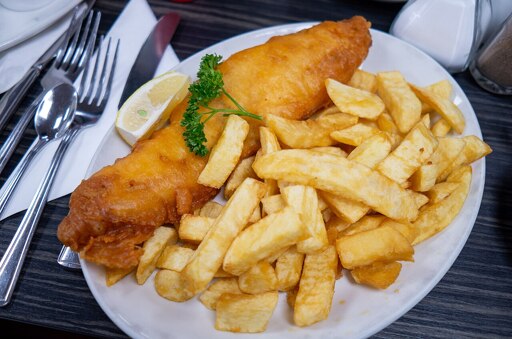
Well thanks, Fish and chips is just wonderful, very expensive these days but a truly beautiful dish.
I’m old enough to remember it being served in old newspaper.
The Vinegar is not as good as it used to be, but the main dish is fine.
I don’t have it as often these days, but personally I like my chips with brown sauce.
Nothing wrong with brown sauce.
Chip shop vinegar is usually a vinegar-like non-brewed condiment. I keep a bottle of proper malt vinegar at home just for fish and chips.
I’ve never been in the UK and this dish is confusing to me on so many levels, and the article doesn’t really help me. How are the chips an essential part of the dish? What’s special about the fish? Is it just that it’s battered? If the fish is special, shouldn’t we just say that chips are the traditional accompaniment, but there’s nothing special about the chips?
It’s fish and chips, of course the chips are essential, without them it’s just fish.
And the important seasoning is newspaper ink.
What about fish and rice? Is that a dish too? Should I write a Wikipedia article about it?
Kedgeree already has a Wikipedia page.
Peanut butter and jelly
Spaghetti and meatballs
Get it?
No way, that’s not at all the same thing. You don’t serve a glob of peanut butter next to the sandwich and the meatballs go into the pasta.
The equivalent is burgers and fries. Bacon and eggs. Soup and crackers.
Almost. It still feels weird somehow.
Peanut and jelly, I would consider that too simple to be a dish, but it’s an emblematic pairing. Maybe if “fish and chips” were presented as an emblematic pairing rather than a dish, that would make sense. I mean, do you consider “hamburger and fries” to be a dish? Or is the hamburger, the dish? I certainly think of the hamburger as being a dish (or rather a template with many variations), and the fries to be the traditional accompaniment.
Meatballs are a prepared ingredient. One that you normally put on spaghetti.
A dish is merely an emblematic grouping of ingredients which we give a name
I don’t consider chana masala, fagioli all’uccelletto, shepherd’s pie, tourtière du Lac-Saint-Jean or crepes to be merely groupings of ingredients which we give a name. They all have a varying set of ingredients with a set of steps, and it gives a final result that’s better (or at least different) than putting each of those ingredients next to each other.
That’s my main issue with considering “fish and chips” as a dish. Unless I’m missing something, it sounds like you’re just putting battered fish next to chips, and they’re not interacting or integrated in any way.
They go together really well, and a piece of fried fried cod or pollock feels lonely without some chips to sop up the excess fishy flavor. The oily flavor of the fish is spread further by the crispy absorbent starch of the chips. They are almost always paired together in the UK and elsewhere because they are very complementary. Beans and toast are similarly popular in the UK as a dish, but haven’t been adopted more broadly. You’re entitled to your somewhat esoteric and clearly strong opinion. Please contribute to the respective wiki entries for “fish” and “chips” with these points and see how they are received.
Thanks, I appreciate the first part of your comment and I find it helpful. It’s the first real and to the point answer I’ve gotten.
Well yeah “nothing special about it” is pretty much a requirement for British food.
If I had just the fish, I would miss the chips. And apparently chips were popular in the UK before the fish, which came later. So really the chips are more than just an accompaniment. The fish, meanwhile is special because people like it.
The thing is I can always go to a chippy shop and just get some chips. I don’t know if they would even sell me solo fish.
Where are the chips?
Right next to the fish.
That’s anti semitic.
Why? Seems pro-semitic to me
Americans think mentioning any ethnicity in any shape or form is racist. Or something.
It’s just a fact? Yes, it’s not vegan, but that wasn’t common enough in the 1800s that we can point to Jews being arguably worse in that regard than others