
My current company makes it real easy. All their simulated phishing addresses use the fictitious TLD of “.corn” so I just setup an email rule to filter them.
I know this is a leap, but for some reason reading this made me want to buy a domain like virus.porn and make it the most wholesome, lemmy community on the planet.
Oh, you mean like penisland.net?
“Handling The Big Jobs, Too”
Lolol
Or girlsof in stagam, which apparently has disappeared but used to be the story of the adventures of a person called Girlsof in the magical realm of Stagram.
I remember that one too, but think it was actually called Slütsof In Stagrâm
I’m unsure if this is satire and that link should stay blue. 😅

Thanks, kind stranger! 😁
This reminded me of notpron.com
Anything but wholesome though…
Be the change you want to see! I’ll sign up straight away.
P1nkman, please report to the training room.

But there’s nothing here 😭
It can be yours for only $69/year!
I wonder if the same leeches hoarding it also “own” plnkman.com…
Nobody owns it, virus.porn is currently unregistered. $69 is the actual price on Namecheap.
plnkman.com (what you linked, with an L) is also available to buy
p1nkman.com is an actual page registered through Porkbun.com since 2021. Maybe this is P1nkman@lemmy.world’s domain, idk.
pinkman.com however is owned by someone through DomainsByProxy.com via GoDaddy. It’s been registered since 2004, and is just parked for ad revenue.
Sure, but i don’t know how to set it up as a fediverse instance.

Just leaving their bare ass out there with no ssl, smh
I tried securing my ass, but my browser got stuck.
It’s only one ssl. How much could it possibly cost? 4 dollars?!
I the worst part is deciding which flavor to get

Jesus… TIL
They can also be gotten for free through many providers, the biggest one in self-hosting is LetsEncrypt
I like that the most expensive one is called “wildcard”.
Sounds like it’s gonna perform AMAZING feats of security some of the time and just not work at all at other times.
Kinda like the wild mage of encryption 😁
WILDCARD SECURITY
It blasts the hackers off the face of the earth with orbital lasers! killer robots sever their network connection! It’s twirling a revolver on its finger while smoking three cigarettes!
And sometimes, that revolver goes off in your face, and it posts your private key on 4Chan.
Isn’t TLS/SSL something at the server level and not the domain provider level?
You have to get a certificate from a provider which can verify you control the domain.
Once you’ve proved control you install the signed certificate with the secret private key on your server.
You can get certificates for free via Let’s Encrypt and a bunch more CA’s. It hasn’t been expensive for ages, unless you want fancy corporate support.
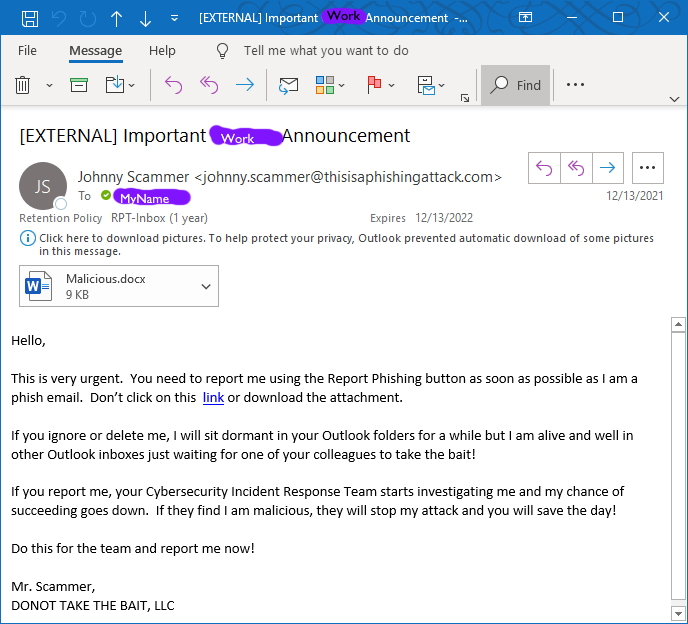
An actual email sent by my company. (not representative of their usual)
This is so cute.
I delight in reporting genuine emails from my company that look like sophisticated phishing attempts, bonus points if they send a follow-up assuring us that the previous sketchy email was in fact genuine.
That’s a crack it open with a hex editor, find who sent it, delete then return a note to the sender letting them know you’ve removed the problematic communication, thankyouverymuch… signed ABiggerCuntThanYou@WhyIsMyCompanyWastingMoneyOnThisShit.org
That’s how you get assigned to IT overflow tickets, NGL. 😅
LOL! from the department of Don’t Threaten Me With a Good Time!
I’m betting that your current workload and their deadlines would be unaffected, is the rub.
Don’t get me wrong, I’m right there with ya! Except for the extra work, doubled expectations, and extreme discount to the co. 🙄🤢🤷🏼♂️
That’s pretty cool. Gets the point across - and the reason and results of why it matters to report instead of ignore. Kudos to your team.
Yeah if anyone falls for this lock them out of their computer immediately.
Clearly he’s trying to trick you into pressing the “Report Phishing” button, which must be some sort of a trap. I’d check the attached document for further clues, especially since he’s telling me not to. Must be something interesting there
…if you delete it, it’ll sit in your inbox? I…what?
I suppose it means to say that it gets moved to trash and sits there.
in the Deleted Items folder. “Delete” just moves the email there. At my company anything older than a month in Deleted Items gets actually deleted. But more importantly if you just delete it, maybe nobody knows it’s’ there. If you report it the outlook team can delete it from the servers.
My place has this thing where most phishing test emails are obvious but every once in a while they’ll drop a really good one, sometimes these even pose as our managers.
The company I work for has lots of training to recognize phishing attempts, and then they proceed to send emails that tick most of the “avoid this” boxes.
Mine includes a header so their mail filter knows to ignore it.
At this point, I’m pretty sure that every employee who has been there for more than a month has written or at least copied a filter to delete any email with that header.
I’ve never been comfortable with that kind of mass deletion and we have, AFAIK, unlimited mailbox storage, so I just set my version to mark those emails as read.
edit: Mail, not mark.
If your company contracts with phish.me then that URL is actually in the email header metadata.
Just set up a rule for the word phish to a special folder, and then you can use the “report” button on everything in that folder to get the credit.
So what do you do when you get an actual phishing mail that doesn’t use that word?
KnowBe4 includes a bunch of headers in the email, including a disclosure saying they have permission to run the simulated phishing test.
I heard a rumour that KnowBe4 have ties to Scientology.
From what some Googling told me, Kevin Mitnick is a scientologist, as is most of the upper management .
Not really relevant here, just interesting…
Where might I find more details to set up filters?
In the gmail web client, I dont see an option to filter off headers. thunderbird lets you set up filters for custom headers, but it’s a bit more complicated.
TBH, i never used it to set up a custom filter, I just knew there were indicators I could use to figure out if an email was in fact a test
My work computer is quite locked down (can’t even install Solitaire or Minesweeper), so I’ll have to set up whatever filter in Outlook. And I think it deletes the messages once flagged as phishing, so I don’t think I have one to inspect right now.
Anyway, some random blog seems to point back to KnowBe4’s whitelisting guide, so I think the filter would need to look for something in the header or for the specified IP addresses?
Tell me more…
Apparently I’m both right and wrong.
At a previous job, there was a header. I can’t remember it directly, but lets say it was like this:
X-Acme-Security-Test: Authorized simulated phishing exercise conducted by KnowBe4 on behalf of Acme Corp for security awareness training and compliance validationApparently KnowBe4 lets customers set their own custom headers. So this was probably set by my company. And not something everyone will see.
But also, they set an
X-PHISHTESTheader. Maybe its a signed header, so they can cryptographically prove the test was in accordance with the customer’s request (this email was sent by us, but it uses YOUR private key, so clearly you were involved here, and we arent just scamming people, or otherwise allows you to validate it at the firewall/spam filter). This isn’t the header I remember, but apparentlly can also be used to detect them – the explicitly say not to do that, but here we are.But if you ever get a knowbe4 phishing test, check the email headers. you’ll probably find something to key off of.
Also there’s a “congratulations you’re a good boy” popup when you click the report phishing button in outlook, so I guess those headers is how the plugin determines whether this is a test email.
Lmfao, .corn sounds like an instance someone would spin up to compete with lemmy.beans
A company I was in a few jobs back had several layers of IT department, there was the local studio department that handled our everyday stuff and a “head office” somewhere far away that set policy and handed out budget and whatnot.
One day “head office” IT decided it was a good idea to send out some fake phishing emails to “test” us. They didn’t tell the local IT department about it, I guess they were also being “tested”. My manager received one and only recognized it as a phishing attempt after he’d clicked just one too many things for it to feel safe to ignore. So he yanked the power on his computer and contacted the local IT department, as is protocol when something potentially dangerous just happened.
The local network went into lockdown while local IT tried to figure out if something actually dangerous had happened. It cost the studio as a whole several hours of work time, which for a studio our size translated to an obscene dollar cost. Nobody on our side of things did anything wrong, even that one extra “dangerous” click my manager did wasn’t something he could be blamed for - head office had crafted the fake phishing attempt well and his reaction to it would have prevented damage had it been real.
Head office never tried a stunt like that again.
Given how common phishing attempts can be though, shutting down for every single one seems like overkill.
Phishing attempts that got far enough to actually show up in our internal corporate inboxes like that aren’t common, though. They’re normally blocked by the layers of firewalls and whatnot. We almost never saw email on those accounts from outside the organization itself, period.
And once you’ve run something capable of remote execution on a machine that’s inside the local network, with the sort of privileges that his machine had (he wasn’t just a bureaucratic sort of manager, he was writing code too), you don’t want to mess around.
All I could think as I read this was Dwight’s fire drill from the office
Kemming is 100 level preparedness.
They need to up their game to cover internationalized homograph vulnerabilities, using roughly similar characters from different international alphabets to create totally different domain names:
They look identical but are entirely different.
They look identical but are entirely different.
They "a"s don’t look identical at all with a good font like Atkinson Hyperlegible Next, which also very clearly differentiates between
- 0 and O
- I and l
etc…
I do have a tendency to check where the link leads before clicking on it, so the difference between those two is quite obvious to me:
http://example.com/vshttp://xn--exmple-4nf.com/, but a lot of people probably do not do that.I would definitely not click on the second one.
Well that’s just rude
I’ve also never fallen for any of the phising emails the IT department sends to test me, my secret is almost never checking my email
My company sends at least one fake phishing email a week. They track stats for them on a security page and I wear it as a badge of honor that my report says 100% viewed and 0% reported.
My company makes you take a course of you fail one or if you ignore 4 or 5 so I have the highest reporting record of the company just because of how much I hate that course
I think they do that at my company too but in addition to not reporting phishing emails I have a personal rule that I don’t do any “mandatory” training unless someone in my management chain specifically asks me to. My boss probably gets annoyed by that occasionally but you’d be surprised how much of that stuff I never get asked about.
Last year our CISO personally reached out to me and asked me to do the course that’s overdue. I was a little nervous for a second and decided to obey.
Yeah that’s a good call. I don’t push back when asked directly I just pretend I didn’t see the emails. Most of the time it’s fine but the boring security stuff is usually the one they get me on.
My guess? Their bonus was tied to 100% compliance and you were one of the last people to do the training.
Nice. My company ties the bonus payment to completing all the mandatory training. You get many reminders from HR when the bonus payment is approaching
So what do you do when you get an actual phishing mail that doesn’t use that TLD?
The phake phish company isn’t monitoring those, so no worries!
If we don’t report the emails as phishing it is considered a fail.
When they first started doing these tests unannounced, our IT department got a horrendous failure rate and then management had to announce that if we recognize it as a phishing simulation, we should still report it, and we also shouldn’t start poking around in the supposed phishing links. 😅
I’ll delete the failure report without reading that either.
I report so many things from executive level because all of the training examples use exec comms as an example.
…and then you don’t get into company Harvard, or what?
lucky you. they fail us if we don’t right click report phishing.
I have over 8000 unread mails in my inbox. Whoever contacts me used Slack. I don’t give a fuck about emails unless DMs me “hey can you maybe answer that customer mail I forwarded you?”
So I would have a fabulous time with such a stupid policy.
Can still set up a header-matching rule - just need to mark the email with a label, so you can report it without even having to read it.
It’s a honey pot of a different color! Genius!
You have chosen Death by chancla
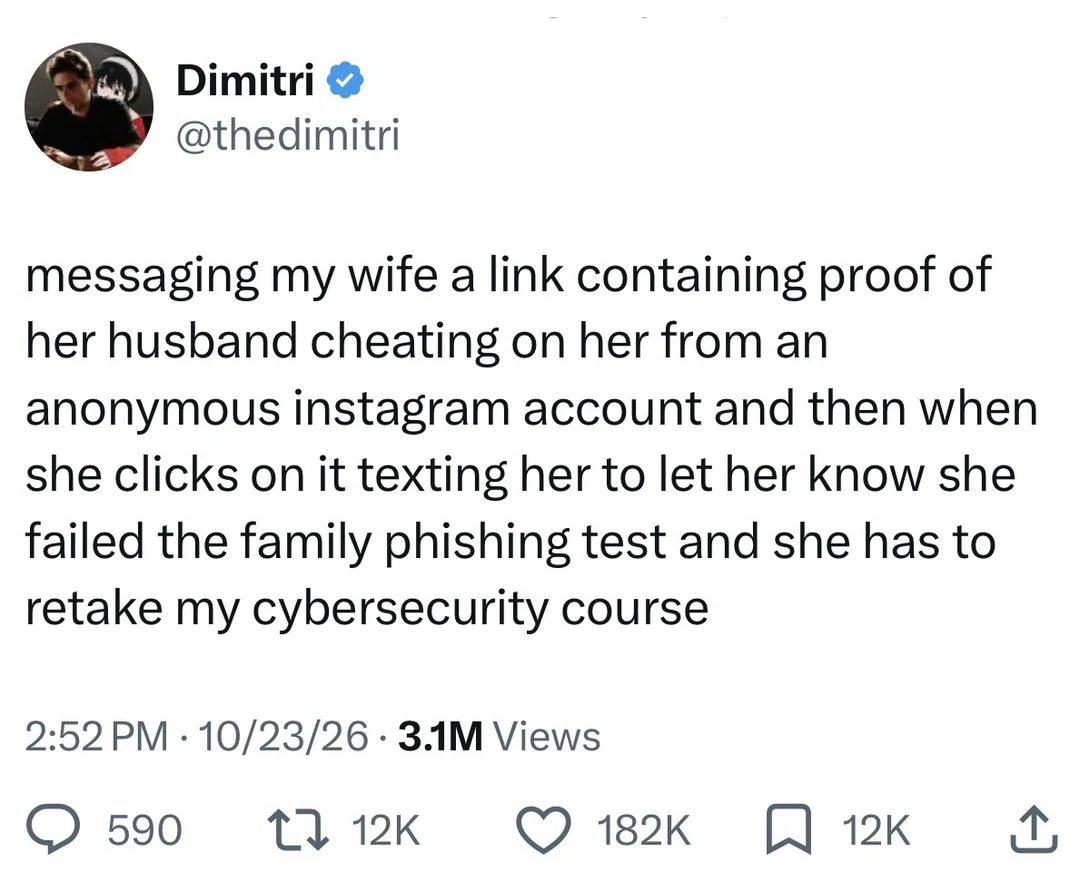
Sounds kinda like the Tale of Foolish Curiosity from Don Quixote. Spoiler: the wife was a good woman and wouldn’t have cheated on the guy… until he started being an asshole by subjecting her to endless tests to prove her virtue.
All these people setting up filters don’t understand it is supposed to train you in case a real phishing attempt is made.
Those filters aren’t going to stop real ones.
But if you want to blow up the database server you need to work on because you couldn’t be bothered to click a button when a phishing test comes around, then you better quit your job in tech.
I swear, developers are some of the biggest security concerns in any company. They complain the moment some access is blocked for good reason. Much bigger concern than old nancy “never-had-a-computer-at-home” clicks-a-lot.
If the fake phishing emails can be caught by my very rudimentary filter they weren’t particularly good anyway. Besides, I still have to look at those emails and report them, otherwise my IT still counts it as a strike against me. Win-win. IT continues to keep me on my toes and I don’t have to take another 30min training course because I ignored an email for a day or two.
His wife is not Italian. If she was he would not even dare to do anything of the sort.
Just don’t read the mails and you won’t get fished
Just read this to a beautiful woman I know.
Her response: That’s not going to end near as well/funny as you think/hope it will.
I like to think I’d find this hilarious if done to me. I found it funny enough to save and send to my friends. On the other hand, I’m reading it as a joke now online, not actually going through it, and I can see how if it had been done to me I might be upset. Not sure if I would have been or not!
(Am woman in a hetero relationship.)
Beautiful (hetro) woman I talk to says: She would find it funny (her husband is a big joker), but yes, it could be stressful at the onset to be told your husband is cheating on you.
Neither is your future if your wife maintains such easily exploited vulnerabilities.
Blink 8 times if you’re in danger
My work email is a .edu, and so most of ours are just social media phishing attempts with fake IG and Tiktok links. But why I’m the world would you use .edu for those?
You wanna target .edu, do a quick check on our publicly accessible faculty pages and pretend to be us. I swear, we’ve got like zero protection against that, lol.
My knee jerk reaction is to calmly explain why this isn’t appropriate in a corporate environment.
I’m so broken.
I saw one with a bunch of maga triggers. The Democrats are doing what!? 😱 they click every time.
I use dried/powdered abortion to slip into my antifa uniform.
Make sure not to get any gender fluid in there too, or the resulting paste makes removal very difficult
May their PCs be infected and their accounts be emptied.
I’ve set my last name in caps. So any IT Phishing script using a <placeholder lastname> just sends my name in caps. And then I just set up a filter.
They should really try and make them more believable
Hello Jelle WHO, You’re no gonna believe it! We’re having issues delivering your packaged extended warranty which claims that your social security bananafits will expire unless you take immediate action. Click this link to know more on how to win big with crypto.
Lol@ “bananafits”
When you promp-inject the AI to use the word banana somewhere.
I failed one of those because I have script blockers on my browser and I wanted to see what the scam was.
The URL is likely unique to identify you as soon as you have clicked.
Simply write a script to cycle through thousands of URLs. The whole company will get identified and then nobody has to retake the training.
I suspect that there are more than a few thousands URLs to if you want to go down that route.
Yeah, that’s why I had to take the online safety course again.
It wouldn’t have been able to do much to my computer though, if it really was a suspicious site.
I got to take security training for that once, too.
It was worth it.
Same, script blocker, virtual machine, etc. Found that apparently you are not meant to forward/report the scam to IT either.
Moral of story: Never inform the company of any suspicious behavior; just ignore it.
There’s a button that says report phishing for many companies
some phishing emails also have a button like that, very funny
Keyword here being “many companies”.
There’s usually nothing wrong with just clicking a link (if your browser is set up correctly). The problem begins if you actually enter any sort of information in a random website or something.
Be extra careful if you’re logged in on any other site in another tab though. Or even if you closed the tab.
The thing is, a link in an email is not any different than a link here on Lemmy, yet we click on those all day. Yes, both could lead to a malicious website, and if you don’t have a recent web browser, then you could get in to trouble without any action.
IMO, the only reason why there is a focus on phishing simulation in orgs is because email is something IT owns and you can easily track who does and doesn’t open an email. If there is a legitimate concern with opening random links, then phishing simulations would also extend to maybe peppering fake links on LinkedIn or other places where IT thinks their co-workers are browsing, but no one (AFAIK) does this.